

The Signalcel
Part 3 of a three-part series on the AI Narrative Gap

A new work paradigm requires new ways of working — different change practice, different communications practice, and ultimately, different roles.
The first two are already being renegotiated, if unevenly. Change management is slowly loosening its grip on the destination-oriented playbook. Communications is experimenting at the edges — recruiting from documentary film, oral history, ethnography, disciplines trained to find meaning in complex human material rather than push a message downward.
Functions accumulate institutional logic over decades. The org chart reflects what the organization has historically needed to optimize, and what it has needed to optimize, until very recently, was output.
The functions that currently carry culture and change inside organizations were built for exactly that. Change managers were built for transitions with knowable destinations. Communications teams were built to transmit a message downward. HR was built for compliance. Culture leads were built to manage sentiment.
None of them were designed to hold open-ended, continuous human signal — to observe organizational life, receive what employees are actually experiencing, and translate it upward as intelligence.
That orientation has no home in the org chart because the org chart was built around a different purpose.
A new paradigm requires it anyway. Which means it requires new kinds of roles.
The Gap, and the Reinvention Already Filling It
The reinvention is already underway. External-facing comms has been the site of genuine experimentation — chief storyteller roles, narrative strategy leads, practitioners recruited from documentary filmmaking, oral history, ethnography. People trained to find meaning in complex human material rather than simply transmit a message.
Stripe offers a clear example. Their communications team has an unusually broad brief — telling the story of infrastructure, of the businesses building on it, of the conditions that make economic growth possible — and they are staffing it accordingly. The hiring call explicitly solicits unorthodox backgrounds and “spiky skills,” and the team reflects it: a backcountry outfitter, a dumpling restaurant founder, a forensic anthropologist. These kinds of hires are a deliberate signal that the function they are building requires a different kind of intelligence than traditional comms produces.
That is an organization that has looked at what communications needs to do in this moment and concluded that the existing model won’t cover it.
Meet: The Signalcel
Let’s call this practitioner the signalcel. (Thanks, roon, for the suffix.) A node for signal rather than message — because every function currently occupying adjacent organizational territory is oriented toward the message: producing it, transmitting it, managing the response to it. The signalcel’s orientation runs the other way. They are there to receive.

Their job is to see, feel, and translate the human experience of organizational disruption in real time, without needing it to resolve.
Michael Gaston left a great comment on Part 1. His framing — the guardian of inefficiency — is the best description of what this requires in practice. In a moment defined by optimization, someone needs to protect the things that look like waste but are critical infrastructure for culture, trust, and meaning.
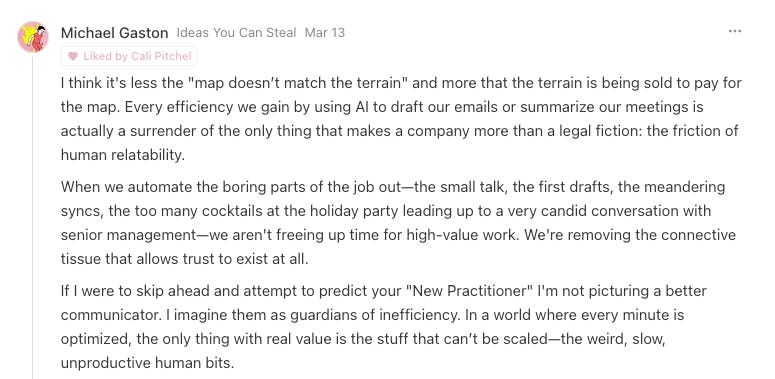
Relationship (i.e., friction) is the medium through which an organization knows itself. Strip it out and the organization becomes faster and blinder simultaneously. The signalcel is the one who can read that friction as signal.
This is also why the Stripe hiring is more than a curious outlier. Forensic anthropology is structurally an upward-facing discipline. You read the evidence. You reconstruct what happened. You bring findings to decision-makers who weren’t there. That is the right model for what organizations are missing.
This practitioner already exists here and there.
They’re just doing it without a name, a brief, or the institutional gravitas that would let it operate at the level of consequence.
So here is my open call for the signalcel:
You need to be going direct. To be signalmaxxing. You need to be hearing — no, listening. Keeping two sets of notes. You need to be relaxing your grip on what you expect to find. Excavating the personal, the intimate, keeping a sharp ear to the heartbeat. Liberate yourself from the summary. Relax into the signal. Trade the map for the territory and dissolve into the living, breathing, deeply weird thing the organization actually is.
Loving that there are two ways to read signalcel and both feel correct.
Reading one: someone who transmits no signal. On purpose. A signal monk. They’ve taken the vow: no producing, no spinning, no broadcasting. Pure receive mode. That’s the practitioner you’re describing.
Reading two: someone who can’t get signal. Surrounded by noise, starved of actual information, locked out of the real thing despite being in every meeting. Doesn’t know they’re starved.
That’s most of the org.
The name works because it holds the tension. The signalcel is voluntarily what the organization is involuntarily. They chose the deprivation everyone else stumbled into.
Which is, honestly, a pretty good definition of what makes someone useful.